
Setting Stop Loss Orders
Stop loss order levels need to be technically consistent, otherwise they will cost you money. Arbitrary levels are likely to be activated by the normal cycle.
Base your stop losses on technical levels, such as:
- Support/resistance levels,
- Above/below the most recent peak/trough,
- Above or below reversal signals; or
- At the crossing of moving averages.
Example
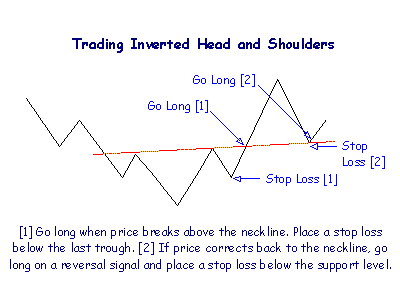
This example illustrates the use of 2 different technical levels for stop losses:
- The first stop loss is placed just below the level of the most recent trough.
- The second stop loss is placed below the support line (on a reversal signal above the support line).
Support and Resistance Levels
Avoid placing your stop loss exactly at the support or resistance level for two reasons:
- Trends often reverse at these levels and you may be stopped out unnecessarily;
- A large number of stops may be set at the support or resistance level, especially where it has formed at a round number.
Rather set your stop loss one or two ticks below a support level or one or two ticks above a resistance level. For example: If a support level has formed at $20.00, set the stop loss at $19.90 so that you are only stopped out if the support level is penetrated.